
AI and Social Equity
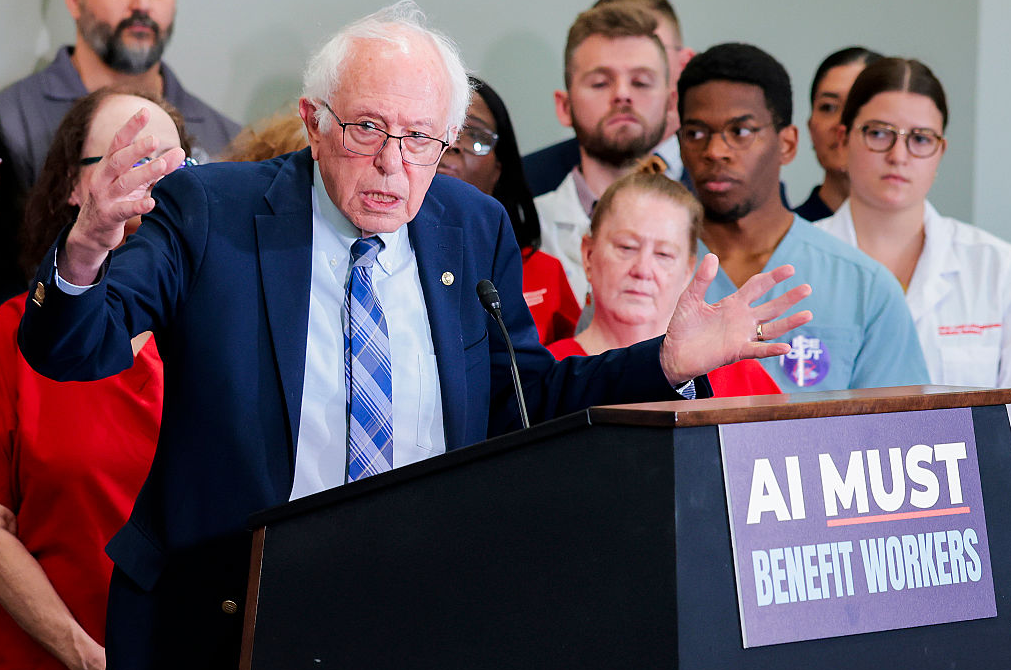
The principal contradiction facing the issue of AI gaining social licence is the reality that all profit will be monopolised by big tech and its wealthy investors. The control of this technology is not socially democratic.
There is virtually no discussion of how the deployment of AI will provide any material benefit to ordinary people. There is only a very generalised discussion that the economy as a whole will benefit from "productivity" gains and that defence and security services require AI to defend against antagonist AI. Sometimes there is discussion on how AI can be used in socially beneficial ways such as reducing the cost of medical diagnostics and possible generation of novel methods to address disease. The distance between the interests of the political class and ordinary people remains immense.
The discussion typically presumes that there will be little social change even as there is much hype on how amazing the technology is and its potential. And there is a lot of discussion on the threat that ungoverned, unregulated AI poses to human life.
It is more than reasonable for many workers to be fearful that their already tenuous employment security will disappear.
There is no discussion of how employment will be generated to replace the jobs that will inevitably be destroyed by AI.
There is no discussion of the cost to individuals in job transitions or extended periods of unemployment. People struggling to pay for housing mortgages dependent on two household incomes have reason to be anxious.
Big tech, social media and the enshitification of service provision are experienced by everyone. AI is simply the next wave of a digital technical revolution and the results are viewed as lacking social benefits even whilst their deployment, consumption and distribution is effectively universal. People generally are not consulted on whether the new tech will be consumed, they simply adopt it whether by choice or whether because it becomes the only choice.
The fear unmentioned is that AI will further disempower human agency. The cost of access will follow the usual model of capitalism so that access that has greatest utility will be charged at a rate that excludes ordinary people, reinforcing existing social stratification and wealth distribution.
And the arrogance of AI's proponents is stunning. The CEO's of AI companies are immediately given access to the nation's PM and senior ministers should they just happen to swing by with a proposal to include Australia in the future. Australia just has to sort out copyright issues. Current proposals suggest a carve out for popular music. Should that succeed, it will just mean that only the popular and prominent might be offered some money. And the rest just won't be included. The same result can be expected for written texts.
Meanwhile the incursion of AI into ordinary life continues. By default, utilisation of web searching is mediated by AI. Large corporates are busy adopting methods that utilise AI. Consultants are using AI to pump out advice and reports effortlessly (errors included). Limitations on free use are already popping up. Job losses have started.
So it is no wonder that popular opposition to providing approvals for new data centres has gained momentum rapidly.
Still, in some respects the question as to whether social licence should be granted for AI deployment is superfluous. It is already being pushed out without any request for approval following a model favoured by the tech industry to move fast and break things.
In the event that it is not given approval or restrictions on its use be imposed in Australia then AI could be accessed from international locations, however, my own estimation is that there is little risk that the Federal government will fail to approve it. The political class want a slice of the investment pie, and the government wants to get a stake in the AI supply chain. The proposal that has been put to the Federal government by Anthropic (now successfully capitalised with its IPO that values the company at $US1.3 trillion) would be the first where model training by a US company would be off shored. The prestige and influence that would flow from that is likely to be irresistable.
So where does that leave the popular movement against data centres?
It will place the movement in direct opposition to the government.
Historically the most obvious analog is the movement against uranium mining, which whilst it mobilised significant protest and opposition, ultimately failed to achieve its ends. Although the fact that there is no nuclear power generation in Australia might be seen as a secondary result, the abundance of coal and the high cost of a nuclear build also contributed to that outcome. The clear similarity is opposition to the deployment of a technology that has risk, is detrimental to the environment in terms of resource usage and the monopolisation of significant profit by multinational corporations. Fifty years later, there will be diverging views of the legacy of the movement. Climate change has renewed interest in nuclear power as a source of non CO2 emitting electrical power production. A generation of activists with environmental concern was created and many of those activists have contributed to activism around climate change. Australian democracy was strengthened with the assertion of the right to protest. Australian democracy also demonstrated that government is subject to overriding economic constraints.
Much has changed. Use of the internet and digital technologies is now ubiquitous. Social media provides a communication channel for good or ill. Laws on protest have been hardened.
Importantly a popular movement would need to crystalize what it is that it seeks to achieve. Would it be complete opposition to AI? Complete opposition to any and all new data centre approvals on the basis of resource usage.
Would it be attainable, reasonable or desired?
Would it be that AI could only be deployed with safety regulation and strict environmental conditions such as only use of desalinated water and renewable power. No builds in environmentally sensitive areas and no builds that disrupt existing communities with noise and traffic.
Would that be enough?
Without challenging the monopolisation of profit and the control of the technology that this delivers avoids the central contradiction. Without seeking equity we would only replicate the powerlessness that ordinary people feel in relation to social media.
No deployment without social equity might not be the catchiest slogan, but think about it - its time we asserted our rights for control of the technologies that govern our lives.
Member discussion