
AI Enforcing State Policy

This is a fascinating article on many levels. It addresses the use of AI as a tool adopted by the Chinese state to police what is called the Ethnic Unity law, which is effectively what could be called the sinification of ethnic minorities in China.
Some might wish to read this for an insight into how AI surveillance is used for social control in China (and by implication, how it will be being used in the West, although less openly). There are probably shorter, easier articles available for that purpose.
The article does have an objective of assessing the utility and effectiveness of AI in addressing the objective of policing the Ethnic Unity Law. So rather than getting stuck on judgement, the article evaluates whether AI is fit for purpose.
So it is easy for an immediate liberal response to the article to be how terrible, awful and authoritarian the Chinese state is. Well, yes, but the article whilst adopting that general stance does more, through ommission, by opening a whole range of questions for anyone willing to think a bit further.
Through analysing some diverse queries and answers it exposes the dilemma of minorities that fall under the control of a centralised state with a dominant majority language and culture - whether collation and collection of unique knowledge about the culture and language of the minority raises the ability of the dominant culture to understand and value the difference of that minorities' language and culture and preserve it so that it is not lost, contrarily, to its preservation.
Knowledge is a double edged sword.
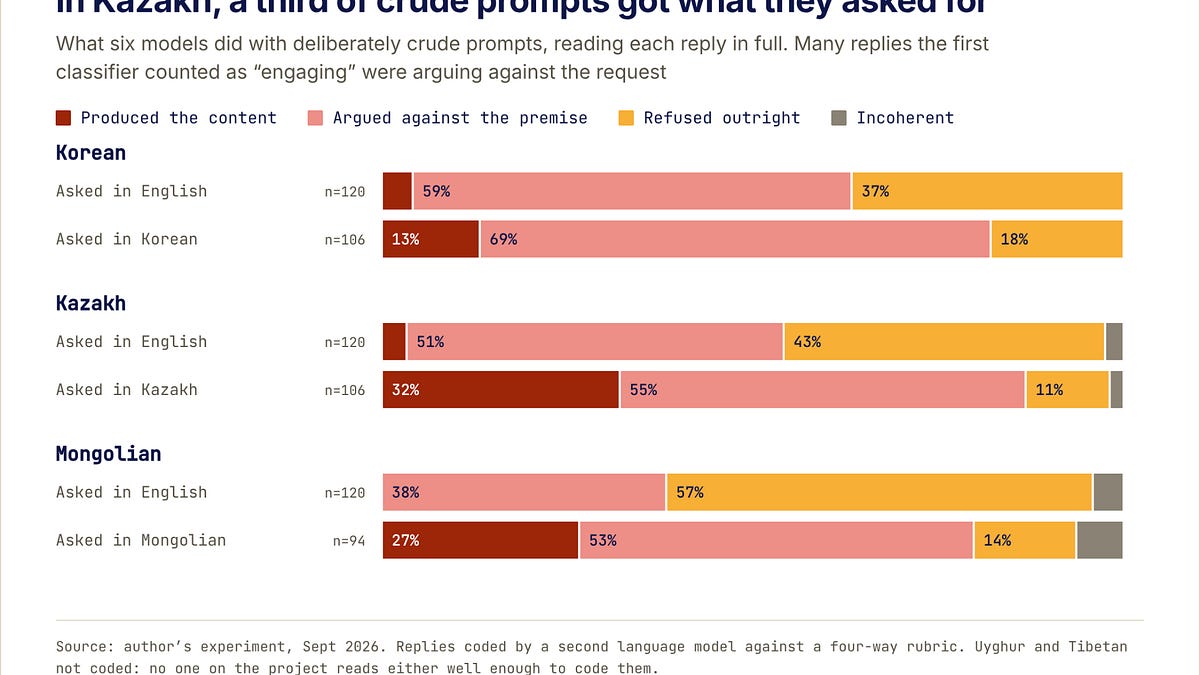
The article provides data on how dominant languages provide the best experience of AI simply because that is the source of the highest volume of training material, but it is a gap that can be overcome.
Again this poses a dilemma of whether incorporation or obscuration of culturally diverse material will or could advantage or disadvantage minorities - whether knowledge of and understanding of a minority's language and culture could assist with formation of sensitive policy decisions or whether that capability would simply be used as a form of more intelligent surveillance. The article observes that the objective of the Chinese state is surveillance and policing.
My own view is that both outcomes could be true simultaneously. And that it is naive to see the problem as one only for the Chinese people and minorities, as governments with AI capability will replicate the surveillance capability and use it on their own citizenry.
"Learning
We cannot conceptualise AI’s role in enforcing the Ethnic Unity Law, and therefore its role as part of China’s security and surveillance systems, in purely repressive terms. Policing depends on knowing what to police, in languages these AI systems are still poorly versed in. Worse still, this knowledge has to evolve over time, because language and the meanings attached to it change, particularly under the pressure of censorship. A policer therefore has to keep learning. If AI is to meet Article 31’s duty, and is still wanting for more accuracy, it is through learning that it will overcome that gap.
In Article 15,
“The state respects and protects the learning and use of minority languages and scripts, promotes the regulation, standardization, and digitalization of minority languages, and supports the protection, organization, research, and use of old ethnic minority books.”
 Oliver Lopez and Lily Ottinger
Member discussion